
Envio Joins Zebra Technologies’ PartnerConnect Program
Ask anyone who runs a fleet of returnable transport items how many they actually have in circulation and you'll get a pause, then a number with the word "roughly" in front of it. Pallets, crates, roll cages, stillages, IBCs. They go out in the thousands and what comes back is a guess. Loss rates in double digits per year are normal in this industry. Not good, but normal. The standard fix has always been to buy 15 or 20 percent more than you need and quietly write off the difference.
That approach just got a shelf life. The EU's Packaging and Packaging Waste Regulation became fully applicable on 12 August 2026, and buried inside it is a shift that most of the coverage has missed.
The headlines have gone to the bans. No more certain single-use formats, limits on empty space in e-commerce parcels, restrictions on substances in food-contact packaging. Fair enough, those are real. But the PPWR (Regulation EU 2025/40, replacing a directive that had been in place since 1994) is doing something bigger than banning things. Because it's a regulation rather than a directive, it applies directly and identically in every member state. One rulebook. And that rulebook says reuse systems must be in place for certain packaging formats now, with binding reuse targets landing on transport, sales and e-commerce packaging from 2030 and tightening through 2040. Member states have to cut packaging waste per head by 5% in 2030, 10% in 2035, 15% in 2040, measured against 2018. Technical documentation for reusable packaging has to be kept for ten years.
Here's the shift. Reusable packaging used to be defined by intent. You bought crates designed for thirty rotations, you called it a reuse programme, job done. Under the PPWR, what counts is whether those rotations actually happen and whether you can show it. Designed-for-reuse and demonstrably-reused are now different things, legally.
Rotation counts. Cycle times. How long assets dwell at each stop. Recovery rates. These are the numbers a reuse regime runs on, and none of them can be produced from a spreadsheet and an annual stocktake. They're properties of individual assets moving through a loop. If you're not identifying and following the assets, you don't have the numbers. You have folklore.
The commercial logic was already pointing this way before the regulation showed up. An RTI pays for itself, in money and in embedded carbon, over many trips. Every crate that sits in a customer's yard for six months, or ends up in a skip, drags the whole programme down. Fleets with real visibility need fewer assets to move the same volume, because a crate you can find is a crate you don't have to replace. Companies that measure their loops will hit the 2030 targets cheaply. Companies that don't will do what they've always done, buy more packaging to cover the losses, which is precisely the behaviour the regulation was written to kill.
This is the bit I find genuinely absurd, and it's the reason Envio exists in the form it does.
A single-use box carries one label for one journey. Sensible. An RTI might do fifty journeys a year, each with a different destination, different contents, different handling notes, and now harmonised PPWR markings on top. The industry's answer to this, for decades, has been to stick a fresh paper label over the old one every single trip. Go and look at a well-travelled crate sometime. Layers of adhesive residue, someone in the washdown area scraping labels off by hand, assets travelling under last week's paperwork because the new label didn't get applied. Paper and glue, endlessly consumed, stuck to packaging whose entire reason for existing is to stop consuming things.
We've built reuse systems and then administered them with single-use consumables. Nobody planned it that way. It just accreted.
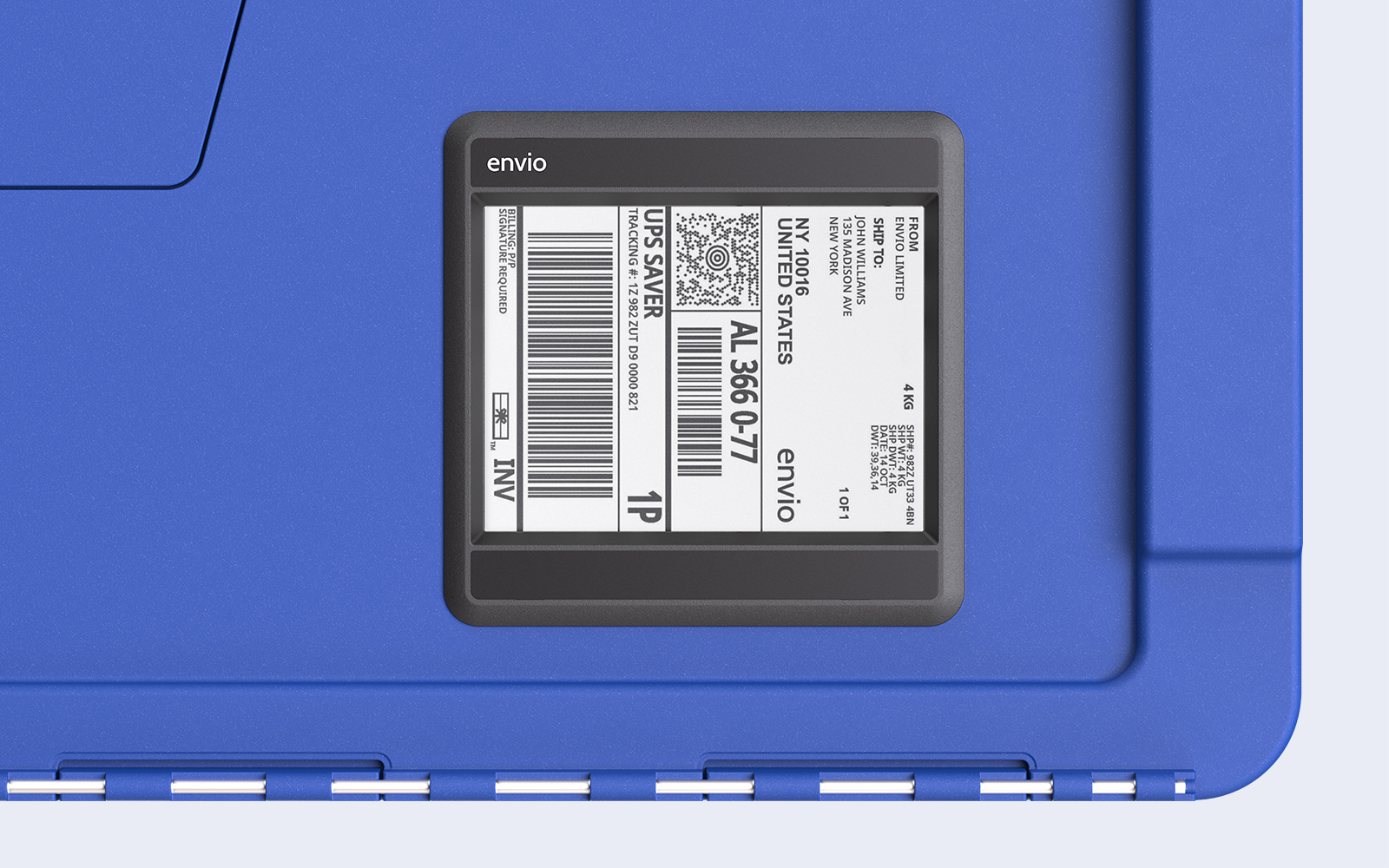
At Envio we put the label on the asset permanently. It's an e-ink display, fixed to the crate or cage, that updates over the air for every journey: consignment details, handling instructions, whatever markings the destination or the regulation requires. Next trip, it redraws. No paper, no residue, no scraping, no crate moving under stale information.
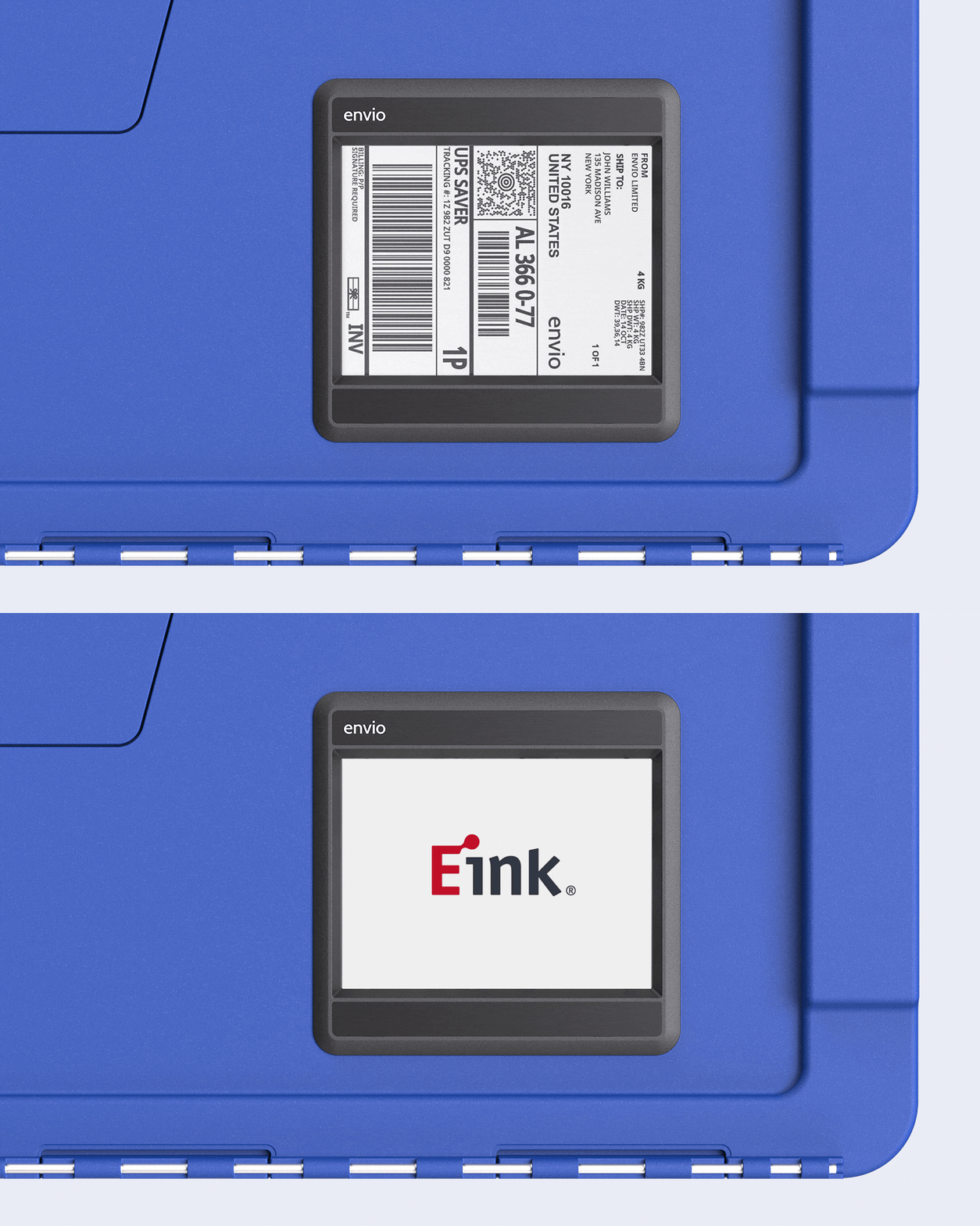
And because that label is a connected device anyway, it earns its keep twice. GPS tells you where every unit actually is, not where your process assumes it should be. Every journey gets logged against the individual asset, so rotation counts and dwell times and loss patterns build up as data. A crate that's been sitting at one site for six weeks becomes something you act on, not something you discover at year-end. When an auditor or a customer asks whether your packaging genuinely circulates, you send an export instead of an estimate.
In my experience the operational wins land well before anyone mentions compliance. Recovered assets, a smaller fleet doing the same work, fewer panic purchases before peak season. The regulatory evidence trail comes along for free, because it's the same data.
The binding targets don't bite until 2030, which sounds comfortable. I'd argue it's the opposite of comfortable, it's exactly enough time and no more. Getting a returnable fleet to circulate reliably is slow work. Fleet sizing, getting partners to actually send things back, reverse logistics, the tracking layer underneath it all. You learn it by running it, not by designing it on paper. Firms that treat the next four years as their proving period will reach 2030 with a working system and years of evidence behind it. Firms that wait will be bolting trackers onto fleets they've already half lost.
What the PPWR has really done is turn packaging into a managed asset class. Managed assets need an identity, a location and a history. A paper label offers none of the three. A tracked RTI with a digital label offers all of them, and that, more than any single article of the regulation, is why we think this technology's moment has arrived.